


Mgr. Klára Zubková, PhD.
In recent years, we have increasingly come across people who are in war zones and share their own accounts, which often resemble news reports. However, they do not always present accurate information, and “I was there, I saw it, I experienced it” does not always reflect reality. In the following paragraphs, I’d like to explain who these influencers are—specifically, war influencers. I’ll also discuss how propaganda works in the online space and how influencers can serve as its carriers. Last but not least, I’ll explain how to recognize them and how to protect yourself from them.
Who exactly are (war) influencers?
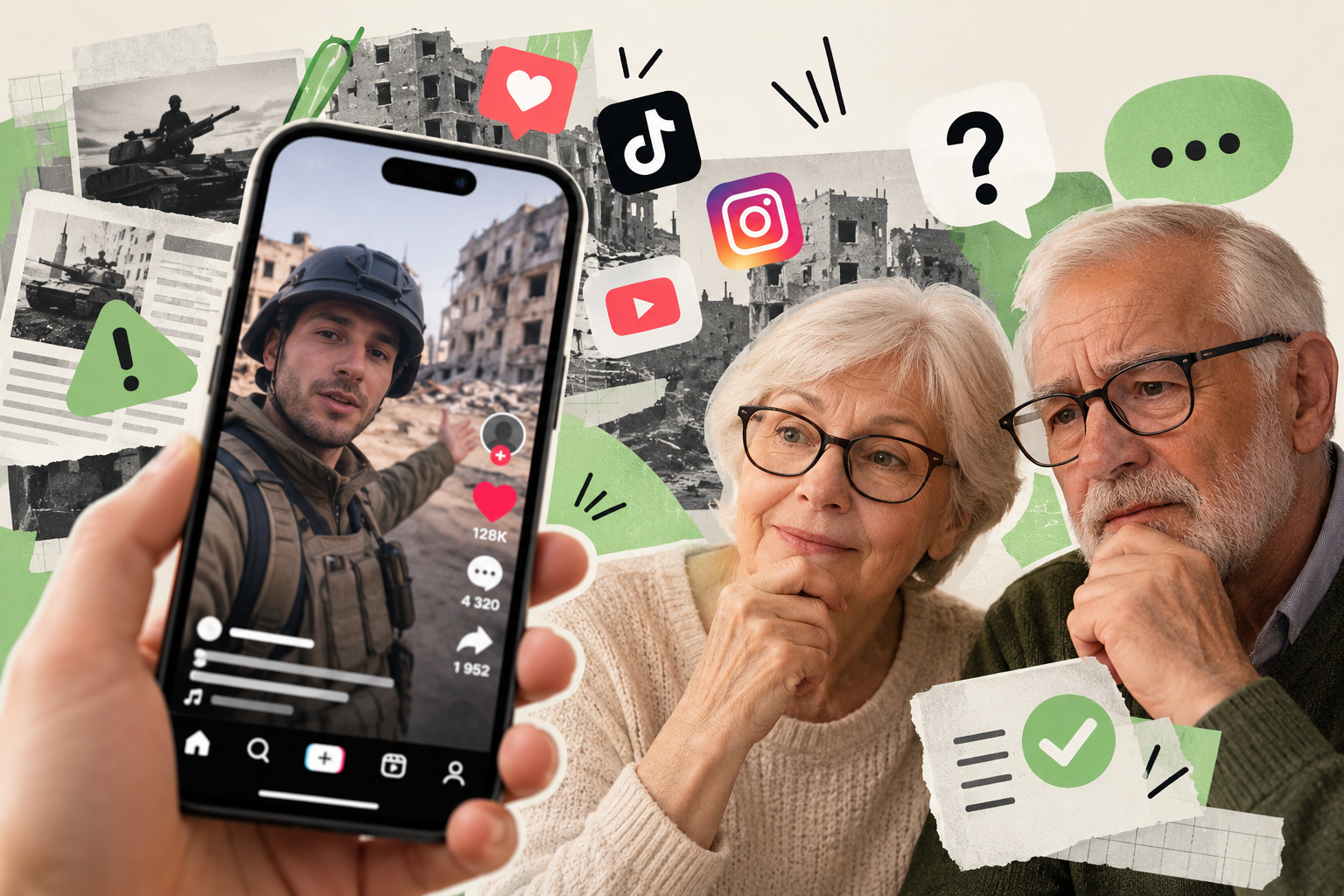
Influencers are people who have a large number of followers on social media (such as Instagram, YouTube, TikTok…) and, as a result, have the ability to influence public opinion. According to Divon and Krutrök (2025), war influencers specifically refer to social media content creators who are located in conflict zones and attract a large audience through unconventional forms of communication—such as humor, irony, or the use of memes.
War influencers can be categorized as follows:
- Celebrity war influencers—these are famous people (such as actors) who leverage their existing popularity and become war activists (such as Sean Penn).
- User-war influencers—ordinary people who were anonymous before creating content from war zones and whose fame increased after publishing this content.
What does the content created by war influencers look like?
Based on an analysis of nearly 100 videos from Ukraine, Divon and Krutrök (2025) identified three categories through which creators depict war:
- POV (first-person view) – videos are filmed to give the viewer the feeling that they are in the war zone themselves.
- Humorous (meme) content – footage shot in war zones is combined with trending humorous (meme) content.
- “Politainment” (a combination of politics and entertainment)—the content is mixed with humor, satire, and political commentary, often using live streams to collect financial contributions from viewers.
Live streaming is the most dangerous, given the rise of scammers who pose as people in war zones solely to extort money from viewers.
Why is this content dangerous?
According to Reuters, up to 54% of people worldwide use social media and videos as a source of information. At the same time, trust in traditional media in Slovakia has fallen to 19%, a historic low. It is precisely this preference for social media and videos that may continue to contribute to the decline in trust in traditional media (Egan, 2026).
Generation Z is particularly vulnerable, as they often form their political views through digital platforms, preferring “personal” forms of communication and trusting individual content creators over official sources of information (Cyhvincev, 2026). However, this does not mean that other generations are unaffected. Older adults, who tend to come into contact with social media relatively later than younger generations, may have different habits when it comes to verifying information. This can be particularly dangerous with content that appears convincing because its author presents the information as “firsthand testimony.”
How can you recognize such content and protect yourself from manipulation?
- Pay attention to who created the content. Try to determine whether the creator is independent or affiliated with a specific organization, the military, or government institutions. Boichak (2023) points out that ties to the government are precisely what such creators may try to hide.
- Don’t rely solely on emotions. Videos that evoke strong emotions (such as sadness, anger, or amusement) are generally the most effective. Rational thinking takes a back seat, making it easier to manipulate the viewer.
- Ask yourself, “What’s missing?” If a video shows only a snippet of reality without explaining the broader context, it may be an intentional attempt to “normalize” the conflict.
- Be cautious when asked for money. For online fundraisers (especially on social media), check whether the organization is verified or if the account is transparent.
- Look for multiple sources. These days, it’s not enough to get information from just one source—especially when it comes to social media. Verify the information through traditional, editorially verified media outlets.
- Remember that even a truthful video can be used for propaganda. Cyhvincev (2026) points out that even real footage can be manipulated to create the impression that war is the only possible solution to a conflict.
War influencers are a modern social media trend. From one perspective, they can provide valuable firsthand accounts of what is happening right in the center of the battlefields. On the other hand, however, they can serve as a tool for propaganda (whether consciously or unconsciously) and for polarizing society. That is why it is important to approach such content with caution, verify sources, and not subscribe to the notion that “seeing with one’s own eyes” through online content automatically means that it is the whole truth.
Bibliography:
Boichak, O. (2023). Mapping the Russian Political Influence Ecosystem: The Night Wolves Biker Gang. Social Media + Society, s. 1–13.
Cyhvincev, I. (2026). Warwashing ako inflyuenserský mechanizmus legitimácie voennej polityky v umovach platformizovanoi publichnoi sfery. Politychni doslidzhennya, č. 1 (11), s. 131–150.
Divon, T., Eriksson Krutrök, M. (2025). The rise of war influencers: Creators, platforms, and the
visibility of conflict zones. Platforms & Society, s. 1–18.
Egan, J. (2026). Overview and key findings of 2026 Digital News Report. Reuters Institute. https://reutersinstitute.politics.ox.ac.uk/digital-news-report/2026/dnr-executive-summary#ftn7
This article was made with an assistance of AI. –